Lakhs of candidates in Maharashtra are waiting for one date: the written exam for the Talathi (Gram Mahsul Adhikari) recruitment under the MPSC. The notification covers 1,539 posts, and the application window closed in August 2026. The exam date is where the confusion lies. Earlier reports pointed to 25 October 2026 in OMR mode, while a later report says the combined exam has moved to 3 January 2027. This article lays out what is confirmed, how the recruitment is structured, how to use the waiting time and what to prepare, with a plain-language look at the job itself and the documents you will need if you qualify.
Last updated: 9 October 2026. Facts below are compiled from published reports and may change, so confirm on mpsc.gov.in before you act.
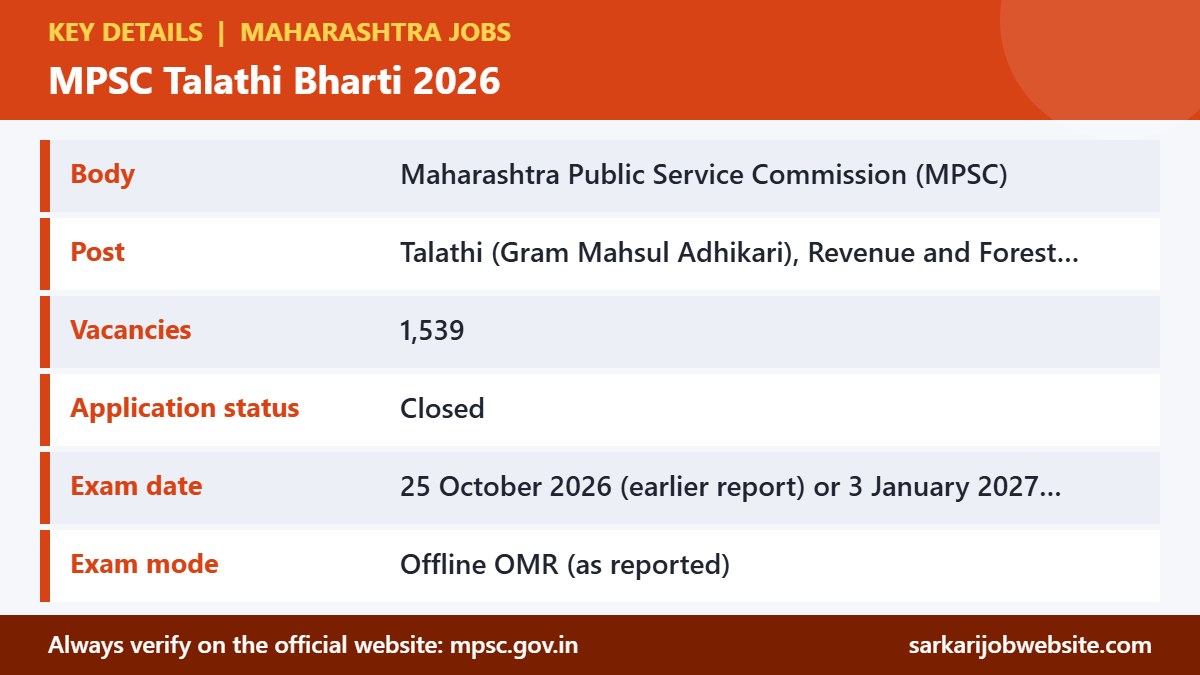
MPSC Talathi 2026 Highlights
| Particular | Details |
|---|---|
| Body | Maharashtra Public Service Commission (MPSC) |
| Post | Talathi (Gram Mahsul Adhikari), Revenue and Forest Department |
| Vacancies | 1,539 |
| Application status | Closed |
| Exam date | 25 October 2026 (earlier report) or 3 January 2027 (later report) – verify |
| Exam mode | Offline OMR (as reported) |
| Qualification | Graduate with MS-CIT (as reported) |
What is confirmed and what is not
Confirmed from the coverage: the recruitment is for 1,539 Talathi posts in the Revenue and Forest Department under the Maharashtra Public Service Commission, the applications are closed (the last date was reported as 10 August 2026, with fee payment extended to 13 August) and the exam is expected to be offline in OMR mode. Not settled: the exam date. Some sources still say 25 October 2026, while one says the Group C combined preliminary exam, of which Talathi is a part, has been postponed to 3 January 2027. Do not make travel plans until your admit card is out.
What a Talathi does
A Talathi is the village-level revenue officer. The work involves maintaining land records (7/12 extracts and mutation entries), conducting crop and land surveys, assisting in revenue collection, issuing certain certificates, supporting relief work during floods or droughts and reporting to the circle officer. It is a field and office job, and you are often the first government contact for villagers. It is a respected, stable post with responsibility.
Eligibility as reported
The reported qualification is a bachelor’s degree from a recognised university along with an MS-CIT certificate. The report does not give the age limit or the fee. Since the application is closed, this matters only for understanding the recruitment and for future cycles. If you applied, you will already have confirmed these.
How the recruitment fits into MPSC Group C
Talathi posts are filled through the combined process of the MPSC for Group C posts. This explains why a Group C schedule change can move the Talathi exam. For more on the combined recruitment, see MPSC Group C 2026 and the Maharashtra government jobs tracker. Marathi readers can see महाराष्ट्र तलाठी भरती 2026.
Preparing now, regardless of the date
The date might move, but the syllabus does not. Spend the waiting time on four areas. First, Marathi grammar and comprehension: sandhi, samas, alankar, proverbs and idioms, and reading passages. Second, English basics: grammar, vocabulary and comprehension. Third, general knowledge and current affairs, with a focus on Maharashtra: geography, history, culture, administration, rivers and agriculture. Fourth, maths and reasoning: percentages, ratios, simple and compound interest, number series, coding-decoding and logical reasoning.
An OMR exam needs OMR practice
An offline OMR exam has its own skill: marking the right bubble quickly and cleanly. Practise with OMR sheets in mock tests. Use a pen as per the admit card instructions, shade the circle completely, and avoid overwriting or erasing. Keep an eye on the question number to avoid shifting an answer by one row, a classic and costly error. Time yourself so that you have two or three minutes at the end to check the OMR sheet.
A study schedule for the next six weeks
- Weeks 1 and 2: grammar and language in the morning, general knowledge in the evening.
- Weeks 3 and 4: maths and reasoning daily, and a timed sectional test every second day.
- Week 5: previous MPSC and Talathi papers, one full paper each day.
- Week 6: revision, short notes and rest.
Documents you will need for the later stages
- SSC, HSC and degree certificates and marksheets.
- MS-CIT or equivalent computer certificate.
- Domicile certificate and, for reserved categories, the caste certificate and the validity certificate.
- Non-creamy layer certificate valid for the relevant year.
- Photograph, signature and Aadhaar.
What to do on the day the admit card is released
Download it immediately, check the name, exam date, shift and centre, and save a PDF. Visit the centre address on a map and plan your route. Ask yourself whether the exam day clashes with another exam, and if so, take a decision early. Keep your ID and the admit card in one folder.
Mistakes to avoid in the weeks before the exam
Candidates in long recruitments tend to burn out, change their plan every week or spend too much time on social media rumours. Stick to one plan, one set of books and one mock series. Avoid comparing yourself with others. If the exam date moves, treat the extra weeks as a gift and use them to strengthen your weakest section. Keep a small list of topics that you get wrong repeatedly and read it every day.
What if you do not qualify
Many successful Talathis qualified in their second or third attempt. After the result, review your score by section, list your weak areas and start preparing for the next MPSC notification right away. The syllabus for Talathi overlaps with several other Group C and state-level exams, so your work will carry over.
What a Talathi career looks like
A Talathi works in a village or a cluster of villages and reports to the circle officer. With experience and departmental exams, a Talathi can move to circle officer and higher revenue posts, according to the rules of the department. The job comes with responsibility, close contact with the public and regular field work. Think about whether you are comfortable with a role that involves land disputes, surveys and demands from many people at once.
Using the waiting period productively
While the exam date is unclear, divide your day into fixed slots: language, general knowledge, maths and reasoning, and revision. Give each subject at least an hour. Take one mock test a week, and keep notes of your mistakes. Avoid constantly checking social media for date updates, since most of it is rumour. Check mpsc.gov.in twice a week and focus on what you control.
Keep your documents updated
Check that your non-creamy layer certificate, caste validity certificate and domicile certificate are valid and in the format the commission requires. Expired certificates are a common reason for rejection at the verification stage, and getting a new one can take weeks. Keep three sets of photocopies of every document, self-attested where required.
Frequently asked questions
Can I still apply for MPSC Talathi 2026?
No. The application window closed in August 2026.
What is the Talathi exam date?
Reports conflict between 25 October 2026 and 3 January 2027. Confirm on mpsc.gov.in.
How many posts are there?
1,539.
Related Government Job Updates
- Maharashtra Govt Jobs October 2026: Kotwal, GMC Chandrapur, SCILAL and More Openings
- BMC Mumbai Group D Recruitment 2026: 115 Posts at Nair, Cooper and Medical College, Status
- Maharashtra ZP Bharti 2026: Zilla Parishad Recruitment Status, Posts and Where to Apply
- Maharashtra Kotwal Bharti 2026: Nashik 156 Posts, Raigad, Sindhudurg and Thane, Last Date 17 October
- Maharashtra Police Bharti 2026: 15,631 Posts Drive Status, Eligibility and Next Recruitment
- UPSSSC Platoon Commander and Block Organizer Result 2026 Declared
- UPSSSC Lekhpal Result 2026: 28,409 Candidates Shortlisted for 7,994 Posts
More in: Maharashtra Govt Jobs | State Govt Jobs | Upcoming Government Jobs | Sarkari Job Website Home