The Supreme Court of India has opened applications for 250 Junior Court Assistant (JCA) posts, and the window is only three weeks long: 7 October to 28 October 2026. This is a Group B non-gazetted job in Pay Level 6 at the country’s top court, and it comes with a typing test and a descriptive paper that many clerical exams do not have. If you are a graduate with decent typing speed, this notice deserves a careful read.
Last updated: 9 October 2026. The details here come from published reports of Advertisement No. F.6/2026-SC (RC) and are labelled “per reports” where they have not been checked against the official PDF. Please verify on sci.gov.in before applying.
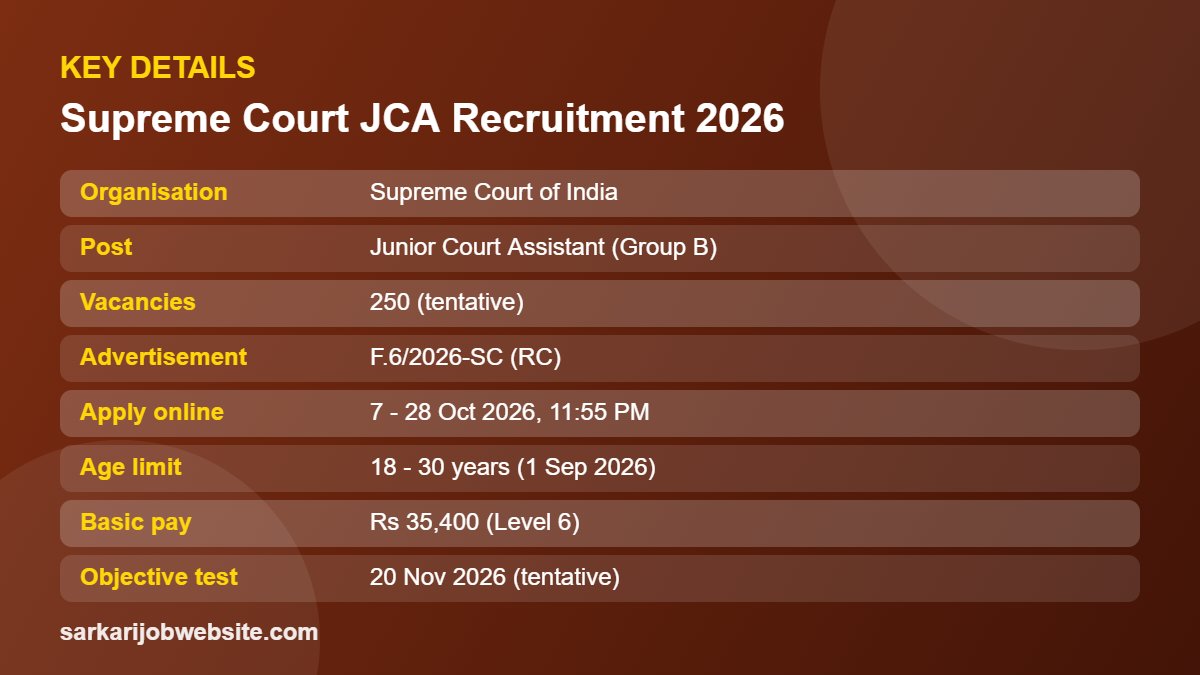
Supreme Court JCA recruitment 2026 at a glance
| Particular | Details |
|---|---|
| Organisation | Supreme Court of India |
| Post | Junior Court Assistant (Group B, non-gazetted) |
| Vacancies | 250 (tentative); category-wise breakup not available in reports |
| Advertisement number | F.6/2026-SC (RC) |
| Online application starts | 7 October 2026 |
| Last date to apply | 28 October 2026, 11:55 PM |
| Age limit | 18 to 30 years as on 1 September 2026 |
| Basic pay | ₹35,400 per month (Level 6) plus allowances |
| Official website | sci.gov.in |
Eligibility criteria
You need a bachelor’s degree from a recognised Indian university, working knowledge of computer operation, and a typing speed of 35 words per minute on a computer. The age limit is 18 to 30 years as on 1 September 2026, with relaxation for reserved categories as per government rules. The reports do not spell out the relaxation figures, so check the notification if you claim a relaxation. Only Indian nationals are eligible.
The typing requirement is not a formality. It is tested as a separate stage with its own qualifying marks, so if your speed is below 35 wpm in English, begin daily practice today instead of after you apply.
Salary and benefits
The initial basic pay is ₹35,400 per month in Level 6, with allowances as admissible under the rules. One aggregator quotes an approximate in-hand salary of about ₹72,040 per month, but it does not cite a source, so I would not rely on that figure. Allowances depend on the city of posting, and Delhi postings usually carry house rent allowance at the higher city rate. Use the official pay matrix to calculate your own number.
Application fee
| Category | Fee |
|---|---|
| General / Unreserved | ₹1,500 |
| SC / ST / OBC (Non-Creamy Layer) / Ex-Servicemen / PwD | ₹750 |
The fee is non-refundable and payable online only; bank charges are extra. Applications cannot be modified or withdrawn after submission, per reports.
Selection process
There are four stages, and you must qualify in each to move to the next.
| Stage | Details | Marks (qualifying) |
|---|---|---|
| 1. Objective test | 100 MCQs, 1.5 hours, 0.25 negative marking per wrong answer | 100 (50) |
| 2. Typing test | English, 35 wpm, 10 minutes, up to 3% errors allowed | 50 (25) |
| 3. Descriptive test | English, 2 hours: comprehension, precis and essay | 100 (50) |
| 4. Interview | Candidates shortlisted about 1:3 against vacancies | 25 (13) |
The objective paper covers General English (20 questions), General Aptitude (15), General Knowledge (15), judiciary provisions in the Constitution (15), Supreme Court Rules 2013 (10), Supreme Court Officers and Servants Rules 1961 (10) and Computer Knowledge (15). The two rules-based sections are what make this exam different from SSC-style clerical papers, so give them real time.
Important dates
- Application opens: 7 October 2026
- Application closes: 28 October 2026, 11:55 PM
- Objective test: 20 November 2026 (tentative)
- Answer key: 22 November 2026 (per reports)
- Objection window: 22 to 23 November 2026, ₹100 per objection, refunded if valid (per reports)
- Typing test, descriptive test and interview dates: to be notified
Note that sources disagree slightly on the exact notification date and typing-test timing, which is another reason to read the official PDF.
How to apply
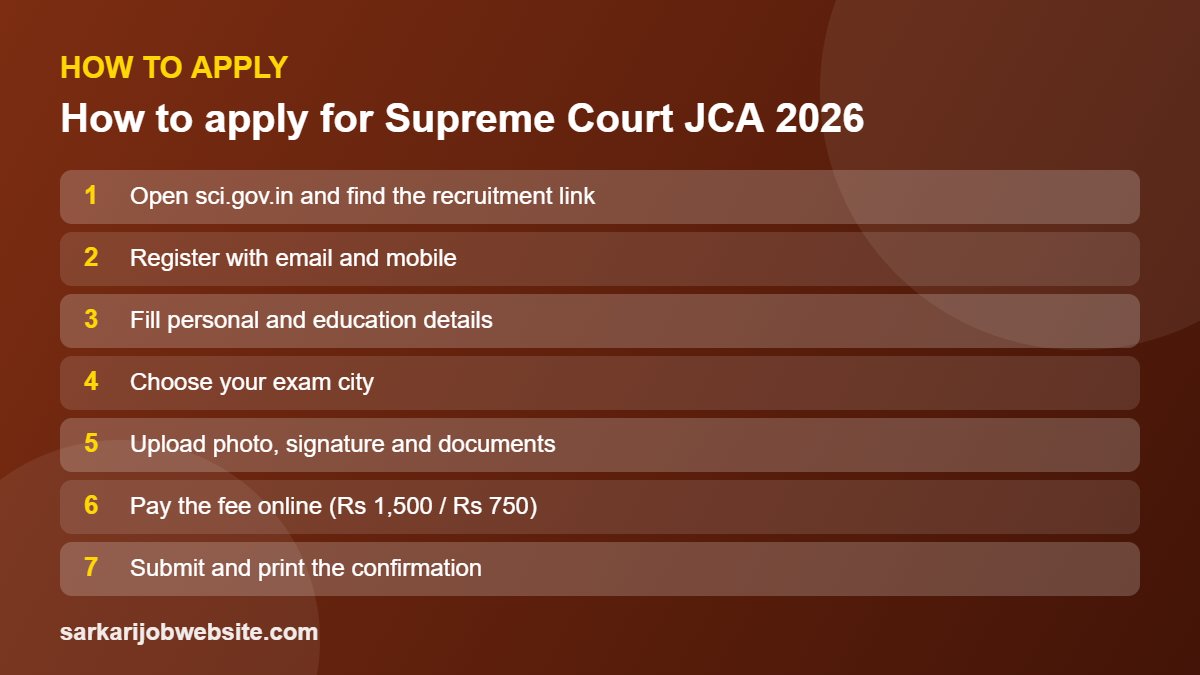
- Visit sci.gov.in and open the recruitment section for Junior Court Assistant.
- Register with a valid email ID and mobile number. Keep both active; OTPs and updates arrive there.
- Fill in personal details, educational qualification and category.
- Select your preferred exam city.
- Upload your photograph, signature and required certificates in the prescribed size and format.
- Pay the fee through the online gateway.
- Submit the form and keep a printout or PDF of the confirmation page.
Preparation tips for the JCA exam
Start with the stage that eliminates the most candidates: typing. Practise 15 minutes a day on a typing tutor and aim for 40 wpm with under 2 percent errors, because the test is strict on word errors. Next, read the Supreme Court Rules 2013 and the Officers and Servants Rules 1961. Both are short compared to a full syllabus and unusually scoring, since few candidates read them. For General English, solve one reading comprehension passage and one precis a day, which also prepares the descriptive paper. Finally, use a free computer fundamentals checklist for MS Office, shortcuts, networking basics and internet terms.
Stage-wise strategy: how to clear all four rounds
Because each stage is qualifying, the real danger is not one weak paper but a single stage you ignore. Treat the objective test as the entry gate and aim well above the 50-mark cutoff, since the final list is built from candidates who clear everything and only the top performers are called for the interview. A realistic target is 70 or more marks, which means attempting about 85 questions with high accuracy. With 0.25 negative marking, guessing blindly costs you; leave a question only if you cannot eliminate at least two options.
For the typing round, take a few practice tests on a computer with the same layout as the exam centre. Stay calm if a word is wrong, because over-correcting wastes more time than the error costs. The descriptive paper is the stage where English-medium school graduates have an edge, but anyone can improve in four weeks by writing one 250-word essay every second day on topics such as the judiciary, technology in courts, legal aid and public administration, and having someone read it. Keep your precis to roughly one third of the original passage and avoid adding your own opinion.
Finally, for the interview, expect questions on your graduation subject, why you want to work in the court system, and basic awareness of how the Supreme Court functions. Read a short overview of the court’s structure, its registry and the roles of court officers before the call arrives.
Common mistakes to avoid
- Leaving the application to the final day. The portal usually slows down in the last 48 hours.
- Ignoring the descriptive paper. Many candidates prepare only MCQs and fail the 50-mark qualifying cutoff.
- Uploading a photo that does not match the specifications, which can lead to rejection.
- Trusting unofficial links. Apply only through links published on sci.gov.in.
Who should apply and who should not
This job suits graduates who enjoy structured clerical and administrative work, can type well in English and are willing to relocate to Delhi. It is a poor fit if your English writing is weak, because two of the four stages test English directly. If you want options in banking or insurance instead, look at the NICL AO recruitment or the SBI specialist cadre officer notice. Railway aspirants can compare the RRB NTPC graduate recruitment.
Related reading
Preparing for another state clerical exam as a backup? See the new TNPSC Group 4 notification and the APPSC recruitment 2026. When the hall ticket is released, our guide on downloading a government exam admit card will help, and the October 2026 upcoming government jobs list keeps all deadlines in one place.
Frequently asked questions
What is the last date for Supreme Court JCA 2026?
28 October 2026 up to 11:55 PM.
What is the salary of a Junior Court Assistant?
The initial basic pay is ₹35,400 per month in Level 6, plus admissible allowances.
Is there a typing test?
Yes. It is an English computer typing test at 35 wpm for 10 minutes, with 25 of 50 marks as the qualifying score.
When is the objective test?
Tentatively 20 November 2026. Confirm on sci.gov.in as the date is not final.