A job portal reports that the IBPS PO prelims result and scorecard were declared on 2 October 2026. If you appeared in the exam, the first thing to do is open ibps.in and check, since the date comes from one aggregator and the official site is the only source that counts. This guide explains how to check your score, how to read the scorecard, what usually happens next in the PO selection and how to plan your mains preparation whether you have qualified or not.
Last updated: 9 October 2026. Facts below are compiled from published reports and may change, so confirm on ibps.in before you act.
IBPS PO Prelims Result Highlights
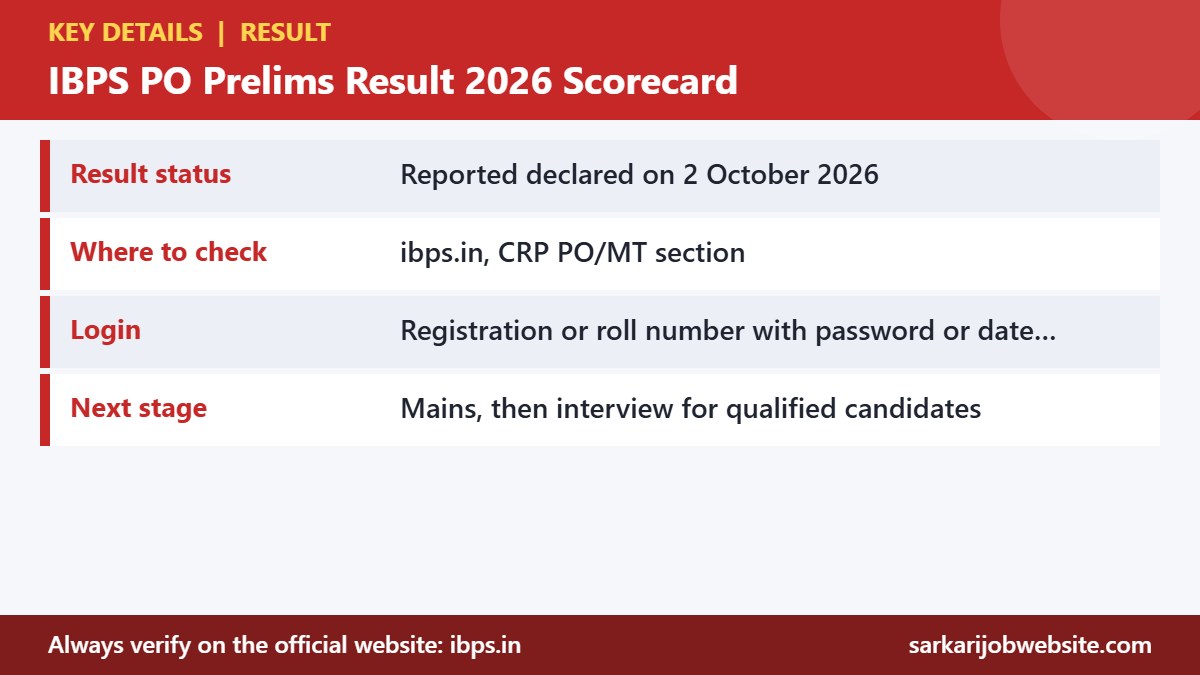
| Particular | Details |
|---|---|
| Result status | Reported declared on 2 October 2026 |
| Where to check | ibps.in, CRP PO/MT section |
| Login | Registration or roll number with password or date of birth |
| Next stage | Mains, then interview for qualified candidates |
How to check the result
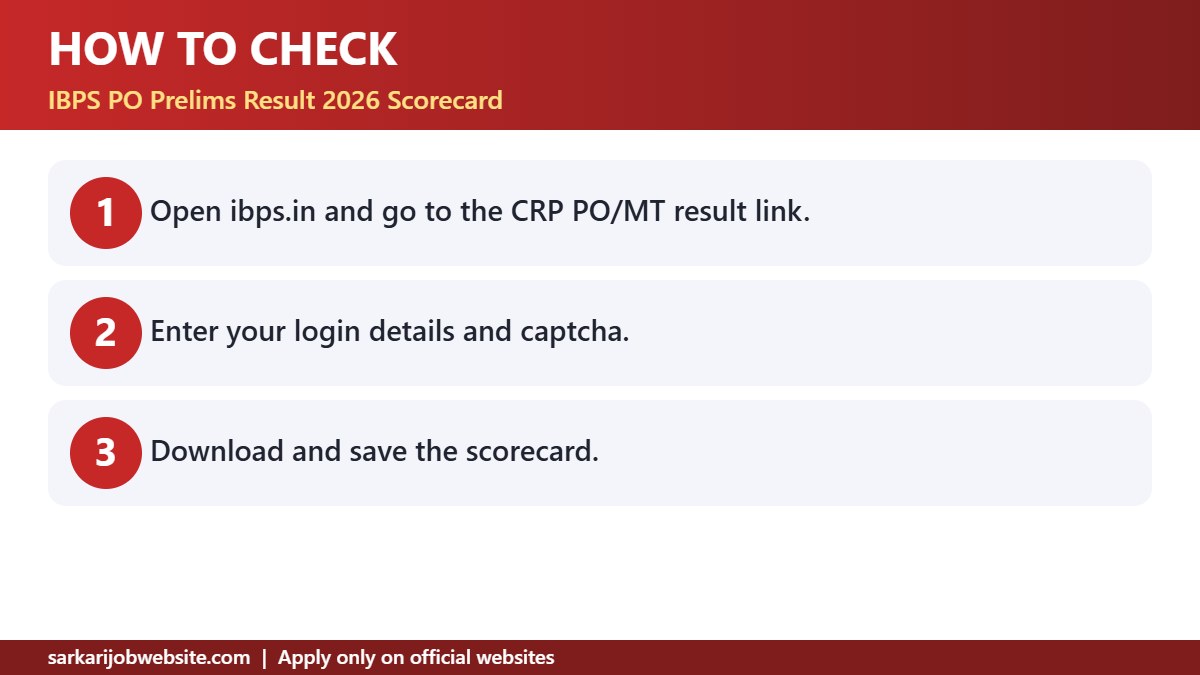
- Open ibps.in and go to the CRP PO/MT section.
- Click the prelims result or scorecard link.
- Enter your registration or roll number and your password or date of birth, plus the captcha.
- Download the scorecard and save it.
IBPS usually keeps scorecards online for a limited period, so take a screenshot and a PDF as soon as you see it.
Understanding the scorecard
The scorecard typically shows your marks in each section, your total score and whether you have qualified for the mains. It may also display the sectional and overall cut-offs for your category and state. A candidate must clear both the sectional cut-offs and the overall cut-off, so a very high score in one section does not rescue a low one. Read the notes at the bottom of the scorecard carefully.
If you have qualified
Congratulations, but do not slow down. The mains is a longer and tougher paper with sections such as reasoning and computer aptitude, data analysis and interpretation, general, economy and banking awareness and English language, and often a descriptive paper. The mains call letter is released on the IBPS site, and the exam date is in the schedule on the website. Start preparing for the mains right away. Marks in the prelims are generally not added to the final merit, so your mains and interview performance decide the final list.
If you have not qualified
This is not the end. A large share of successful PO candidates clear an exam in their second or third attempt. Compare your sectional scores with the cut-offs, identify the weakest section and plan the next attempt. Use your marks as data, not as a verdict. Think about whether time management, accuracy or concepts were your biggest issue and address that first.
How cut-offs are decided
Cut-off marks depend on the difficulty of the paper, the number of vacancies and the number of candidates. In multi-shift exams, IBPS normalises scores so that shift difficulty does not unfairly help or hurt anybody. That is why your raw score can differ from your scaled score, and why two candidates with the same raw marks may have different final scores.
What the mains stage usually involves
For IBPS PO, the mains is a computer-based test with objective sections and a descriptive English paper. The interview follows for candidates who qualify. The exact pattern, marks and timing for this cycle are in the notification, so read them and match your preparation. If you are not sure, take a full mock of the previous year’s pattern as a baseline and see which sections need work.
A four-week mains plan
Week 1: strengthen the data interpretation and reasoning puzzles that carry the most marks. Week 2: banking and economy awareness. Read monthly capsules and revise key terms like repo rate, CRR, SLR, NPA and financial inclusion schemes. Week 3: English: reading comprehension, cloze and the descriptive paper. Week 4: full-length mocks and revision. Practise the descriptive paper by writing a letter and an essay every alternate day within the time limit.
Documents for the later stages
- Graduation marksheets and degree certificate.
- Category certificates in the prescribed format.
- Proof of date of birth and ID.
- Photographs and the signature in the required form.
Fake result sites
On result day, many fake sites appear. IBPS never asks for a fee to show your result or to “boost” your rank. Use only ibps.in, and never share your password with anyone. If a message claims to guarantee a PO selection for money, ignore and report it.
Related bank exams
If you are also preparing for clerk exams, see the IBPS Clerk prelims admit card guide. For officer-level insurance exams, see the NICL AO guide, and for results in general, our guide on how to check a sarkari result.
Interview preparation starts earlier than you think
The IBPS PO interview is a personality and aptitude assessment. Candidates who start preparing only after the mains result usually find the time too short. Begin by writing your own profile: education, hobbies, strengths, a few achievements and honest reasons for choosing banking. Practise speaking about each point in a minute. Read about the banks participating in the PO selection and their recent news. Keep up with current affairs, particularly economy, banking and government schemes, because the panel often starts with a question from your own profile and then moves to current topics.
How PO selection continues after the prelims
The IBPS PO process has three stages: prelims, mains and interview. The prelims is qualifying, the mains tests your knowledge across several subjects and the interview assesses personality and communication. The final merit list combines the mains and interview scores according to a weightage stated in the notification. Candidates who clear the prelims often make the mistake of continuing with prelims-style practice. The mains rewards depth, so move to longer practice sets in data interpretation, puzzles and banking awareness.
Banking and economy awareness: where to start
Read a monthly current affairs capsule and one business newspaper. Make a glossary of banking terms such as repo rate, reverse repo, CRR, SLR, NPA, MCLR, priority sector lending, financial inclusion and digital payment systems, and revise it weekly. Follow RBI announcements and budget themes. Questions on these topics are direct and scoring if you have prepared regularly, and your interviewers may also ask about them.
Interview basics
Prepare a short, honest introduction. Know your resume well, including your hobbies and any gap years. Practise answering why you want to join banking, why a public sector bank and how you handle pressure. Dress formally, arrive early and carry your documents in the order the call letter lists. Remember that an interview is a conversation, and honest, clear answers work better than rehearsed speeches.
Keep your documents ready
If you have qualified, keep your graduation certificate, category certificate and ID ready, along with passport-size photographs. Mains call letters and interview notices come with short timelines, so being prepared saves stress.
Frequently asked questions
Is the IBPS PO prelims result out?
It is reported declared on 2 October 2026. Confirm on ibps.in.
Where do I check the scorecard?
On ibps.in, in the CRP PO/MT section.
What comes after the prelims?
Mains and then an interview for qualified candidates.
Related Government Job Updates
- IBPS Clerk Prelims Admit Card 2026 Out: Exam 10 and 11 October, Download Link and Shift Timings
- SBI Specialist Cadre Officer Recruitment 2026: Apply Online by 21 October
- Bank of Baroda Recruitment 2026: 1,100 Wealth Executive and Credit Analyst Posts
- Canara Bank Graduate Apprentice Recruitment 2026: 3,500 Posts, Apply by 17 October
- RRB Group D Result 2026: Expected Date, Scorecard, Cut Off and How to Check
- NICL AO Recruitment 2026: 321 Administrative Officer Vacancies, Apply Online, Salary, Eligibility
More in: Bank & Insurance Jobs | Results & Answer Keys | Upcoming Government Jobs | Sarkari Job Website Home