Results are the moment when months of preparation turn into a number, and that number comes with a set of unfamiliar words: scorecard, merit list, cut-off, normalisation, provisional list, waiting list. Candidates often check only whether their roll number appears on a list and miss what comes next, with the result that dates for verification or counselling pass quietly. This guide explains how to check a sarkari result, how to read each document, what cut-offs really mean and what to do in the first two days after the result, whether you have qualified or not.
Last updated: 9 October 2026. Facts below are compiled from published reports and may change, so confirm on the official website of your exam body before you act.
Result Basics
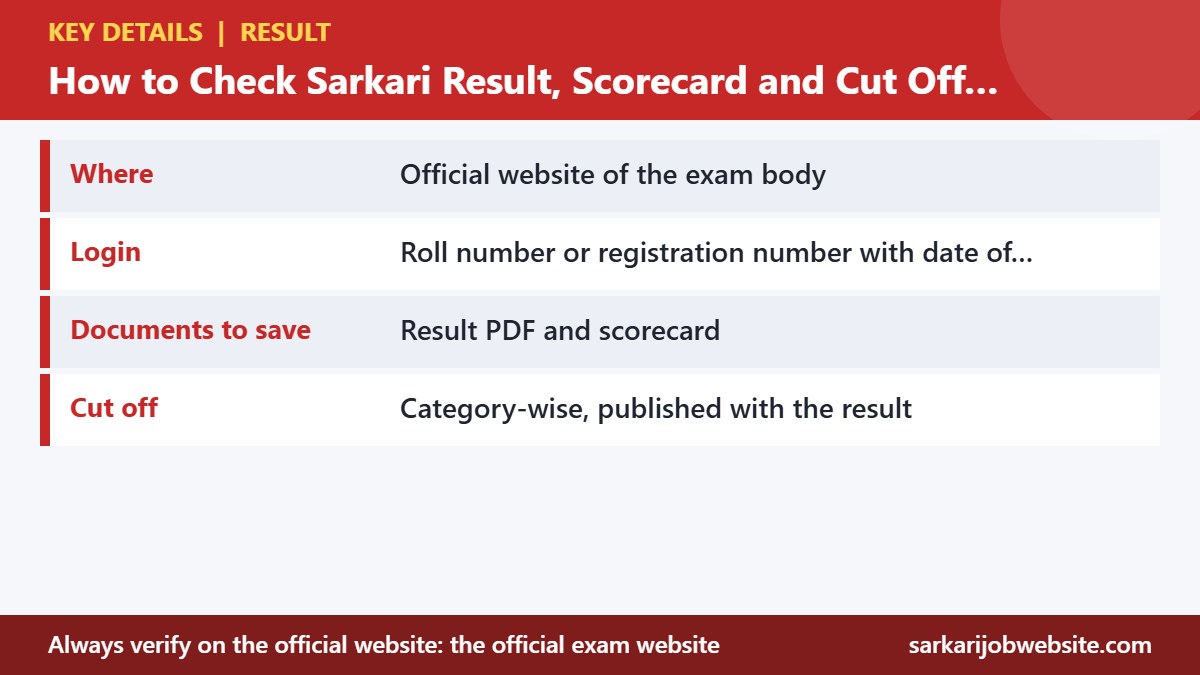
| Particular | Details |
|---|---|
| Where | Official website of the exam body |
| Login | Roll number or registration number with date of birth or password |
| Documents to save | Result PDF and scorecard |
| Cut off | Category-wise, published with the result |
Where to check a result
Only on the official website of the body that conducted the exam. That is ssc.gov.in for SSC, ibps.in for IBPS, the regional RRB websites for railways, upsc.gov.in for UPSC and the commission or board websites for state exams. Results are free. Websites that ask for money to show you a result or to improve your rank are scams.
Steps to check
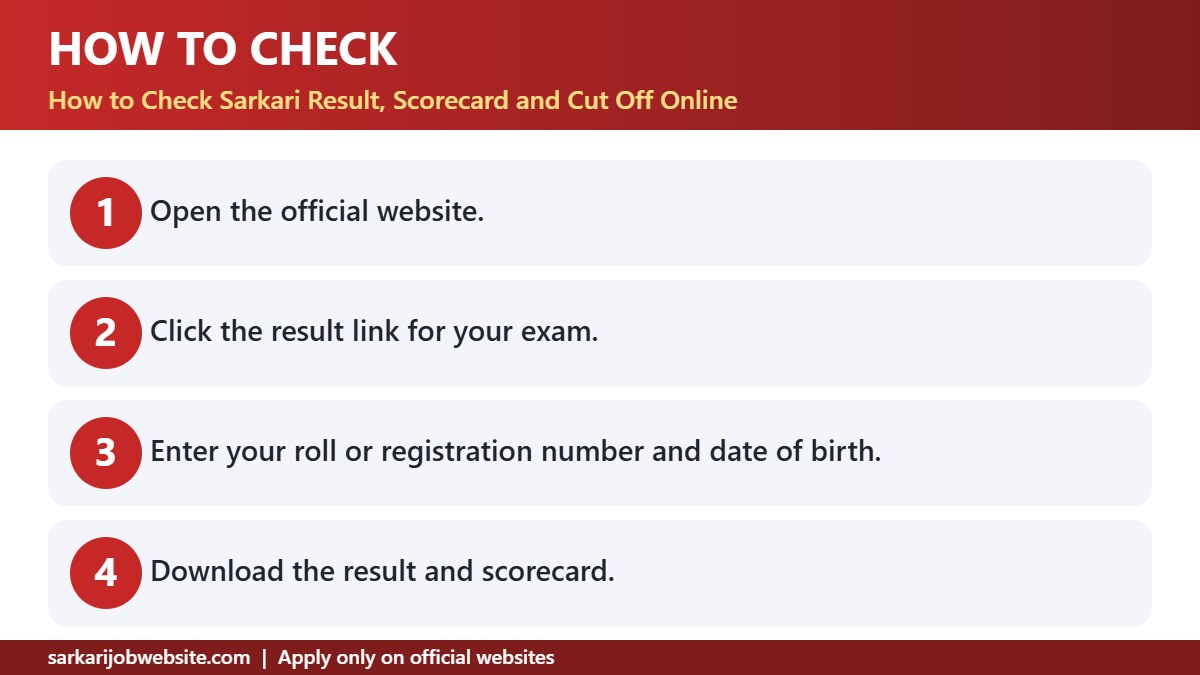
- Open the official website and find the Results section.
- Click on the result link for your exam and year.
- Enter your roll number or registration number and your date of birth or password, along with the captcha.
- View the result and download the scorecard if it is available.
- Save the PDF and a screenshot. Take a printout.
On some websites, the result is a PDF with roll numbers, and you search the file using the find option (Ctrl+F) with your roll number.
The words you will see
- Result: shows whether you have qualified for the next stage, or your marks.
- Scorecard: a document with your marks, often section-wise, along with category cut-offs.
- Merit list: a ranked list of candidates, used to select candidates for posts.
- Cut-off: the minimum marks required for a category to qualify or be selected.
- Provisional list: a list that may change after verification or the resolution of objections.
- Waiting list: candidates who may be called if selected candidates do not join.
How cut-offs are set
A cut-off is not a fixed number announced before the exam. It depends on the number of vacancies, the number of candidates, the difficulty of the paper and the reservation rules. In exams with many shifts, boards normalise the scores so that candidates in a harder shift are not at a disadvantage. That is why your raw marks can differ from the marks on the scorecard. Compare yourself only with the cut-off for your own category and region.
Normalisation, in simple words
When an exam is held over many days with different question papers, one paper may be slightly tougher than another. Normalisation adjusts scores using a formula given in the notice, so that the final ranking is fair across shifts. You do not need to understand the formula. What matters is that you check the normalised score on the scorecard, because that is what is compared with the cut-off.
What to do within 48 hours of a result
- Download and save your result, scorecard and any notice.
- Read the notice for the next stage, with dates and documents.
- Check your details. If anything is wrong, write to the helpdesk with proof.
- Prepare your documents in the order given.
- If you did not qualify, check your section-wise scores and plan the next attempt.
If you qualified
Do not relax. Next stages such as the mains, physical test, document verification or counselling have their own dates, and missing one can cancel your candidature. Prepare the documents listed in the notice. If you are asked to fill a preference form, think carefully about your choices, since they may not be changed later.
If you did not qualify
It is disappointing, but use the result as feedback. Look at your section-wise marks and compare with the cut-off. If you were close, a small improvement in accuracy may be enough next time. If you were far, identify the weakest sections and the reasons, whether concepts, speed or accuracy. Set a plan for the next exam, with weekly goals, mock tests and revision. Many selected candidates succeeded on a later attempt.
Answer keys and objections
Before a final result, many boards release a provisional answer key and open a window for objections. The window is short and may require a fee per question. Raise an objection only if you have a reliable source, such as a textbook or an official document, and attach it. If the board accepts, marks are corrected for all candidates.
Scams around results
On result day, scammers send messages claiming to give early results, change marks or promise selection for money. No one can change your marks. Never pay for a result or share OTPs. Use only official websites and report suspicious messages.
Where to follow results
See our sarkari results tracker for October 2026 and the results and answer keys section.
Keep a record of every exam you take
Make a simple spreadsheet or notebook with one line per exam: name, date, your registration number, the result date, your marks and the cut-off for your category. Over a year or two, this record shows how your score is improving and which sections drag you down. It also saves time when you need to quote your registration number or raise a query. Save every PDF in a folder named after the exam so that you can find it quickly.
Do not compare marks across different exams
A score of 120 in one exam may be excellent, while the same score in another may be below the cut-off. Papers differ in difficulty, in the number of questions and in marking. Compare your marks only with the cut-off and the average of that exam, not with a friend who took a different one.
Results that come in stages
Large recruitments publish results in stages: first the written exam result, then the mains or physical test results, then the final merit list. Each stage has its own notice, dates and documents. Keep a note of the stage you are in, the next date and the documents required, and check the official website at least twice a week during the process. Many candidates lose a stage by assuming that the next notice will come to them by message.
If you disagree with your result
If you believe there is an error in your marks, check the notice for a grievance or re-evaluation process. Write a short, polite message with your roll number, the issue and proof, within the time limit given. Most boards do not reconsider results after the deadline, so act quickly and keep a copy of your message. In computer-based exams, the response sheet is your best evidence, so download and keep it.
Frequently asked questions
What is the difference between a result and a merit list?
A result shows who has qualified or your marks. A merit list ranks selected candidates.
Is the cut-off the same for all candidates?
No. It differs by category and often by state or zone.
How long is a scorecard available?
Often for a limited period, so download it on the day of the result.
Related Government Job Updates
- NTA UGC NET June 2026 Re-exam Result Declared: How to Check Scorecard
- UPSSSC Platoon Commander and Block Organizer Result 2026 Declared
- UPSSSC Lekhpal Result 2026: 28,409 Candidates Shortlisted for 7,994 Posts
- IBPS PO Prelims Result 2026 Scorecard: How to Check and Next Steps
- RRB Group D Result 2026: Expected Date, Scorecard, Cut Off and How to Check
- Sarkari Results This Week: HPSC ADO, RPSC Deputy Jailor, NTA AIAPGET, Bihar DElEd and TNPSC Answer Key
More in: Results & Answer Keys | Upcoming Government Jobs | Sarkari Job Website Home